




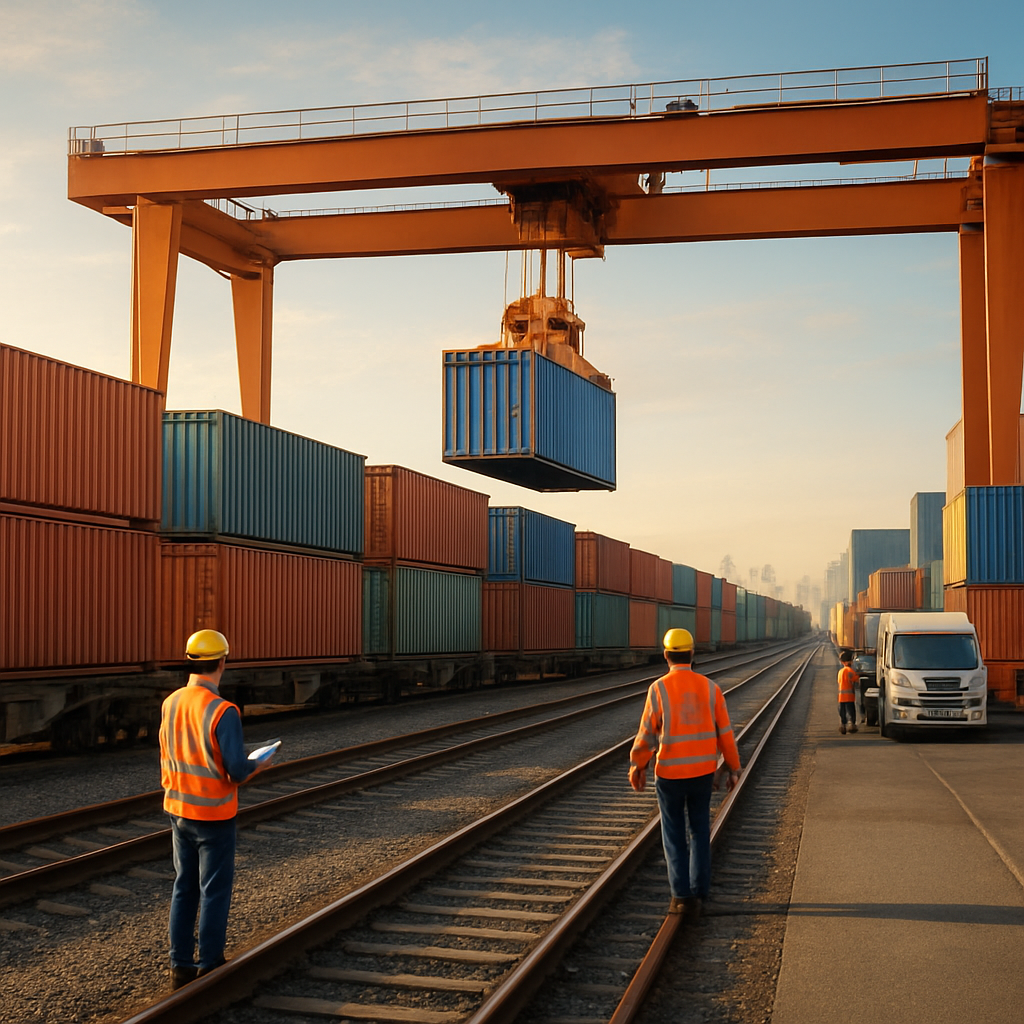
Container Rail Freight: Efficient Solutions for Australian Businesses
Container Rail Freight: Efficient Solutions for Australian Businesses is fast becoming a board-level discussion rather than a back-office procurement choice. As margins tighten and decarbonisation pressures increase, Australian shippers are re-evaluating how containerised flows move between ports, distribution centres and regional production hubs. The strategic question is no longer whether rail is relevant, but how quickly organisations can redesign freight transportation solutions to capture its economic and environmental advantages.
Boards that treat rail as a tactical overflow mode are missing its potential as a structural lever for cost, carbon and resilience across the logistics and supply chain.
Container rail is especially compelling on long-haul East–West and North–South corridors, where scale economics drive down cost per TEU and increase schedule reliability. Double-stacked services where clearances allow, coupled with longer consist lengths, help rail compete strongly with congested road corridors. For flows above roughly 500 kilometres, many shippers now find that rail freight transportation solutions offer a more predictable total landed cost than purely road-based options.
Why container rail freight matters now
Several structural forces are reshaping the business case. On the supply side, investments such as the Botany Rail Duplication, Cabramatta Loop and new terminals at Moorebank and Kenwick are easing historical bottlenecks between ports and inland customers. On the demand side, investors and regulators are scrutinising Scope 3 emissions, making mode choice a visible component of sustainable freight logistics and supply chain strategies. When combined with fuel volatility and driver shortages, the timing strongly favours a serious reassessment of rail.
Container rail freight as a climate and competitiveness lever
Rail Freight in Australia is widely recognised as more carbon-efficient than road, with emissions per tonne-kilometre significantly lower than heavy vehicles. According to the Australian Government’s National Greenhouse Accounts Factors (https://www.dcceew.gov.au/climate-change/publications/national-greenhouse-accounts-factors-2024), shifting a material share of freight kilometres to rail can materially support science-based targets while keeping costs under control. Emerging biofuel, battery-electric and hydrogen locomotive trials indicate that today’s gains are only a stepping stone to deeper decarbonisation, giving exporters the chance to differentiate in climate-conscious markets.
The real unlock lies in integrating rail into end-to-end intermodal shipping services rather than treating it as an isolated trunk haul. Modern terminals such as Moorebank Interstate Terminal and Kenwick Intermodal Terminal enable efficient port to warehouse intermodal services, with shuttle trucks handling short urban legs and trains handling the long distance freight transportation by rail task. For many sectors, container rail intermodal shipping solutions now provide comparable transit times to road while materially reducing congestion risk.
Strategic integration into end-to-end logistics
To realise full value, organisations must move beyond mode-by-mode procurement. Leading shippers are tendering for rail based intermodal shipping services wrapped within integrated logistics and supply chain planning, ensuring that inventory positioning, warehouse locations and contract structures all support rail utilisation. Done well, cost effective rail freight logistics can also enhance resilience by diversifying away from over-reliance on a single mode, corridor or carrier.
From a governance perspective, executives should embed mode-shift targets and emissions performance into freight RFQs and KPIs, not just price and service metrics. Mapping current lanes over 500 kilometres, testing pilots on one or two high-volume routes, and then scaling based on performance allows businesses to build confidence without disrupting operations. As infrastructure, policy incentives and service offerings mature, container rail freight will increasingly define competitive benchmarks for Australian freight transportation solutions.
Now is the time for logistics and supply chain leaders to revisit their domestic and export freight strategies through a rail-first lens. Review your network, test targeted pilots, and engage specialist advisers to quantify the commercial and emissions upside. To explore how container rail freight could reshape your cost base and risk profile, start by assessing your highest-volume corridors and identifying where rail-enabled solutions can be deployed within the next planning cycle.

Related posts
The Evolving Landscape of Road and Rail Freight: Trends and Challenges in 2024
The road and rail freight industry has always been the backbone of global trade,
Rail Freight Forwarding: Streamlining Your Supply Chain
Explore how Rail Freight forwarding in Australia can cut costs, reduce emissions
Descartes Report Shows Robust Port and Imports Activity in May
Another month brought another strong month of United States-based imports, accor
