




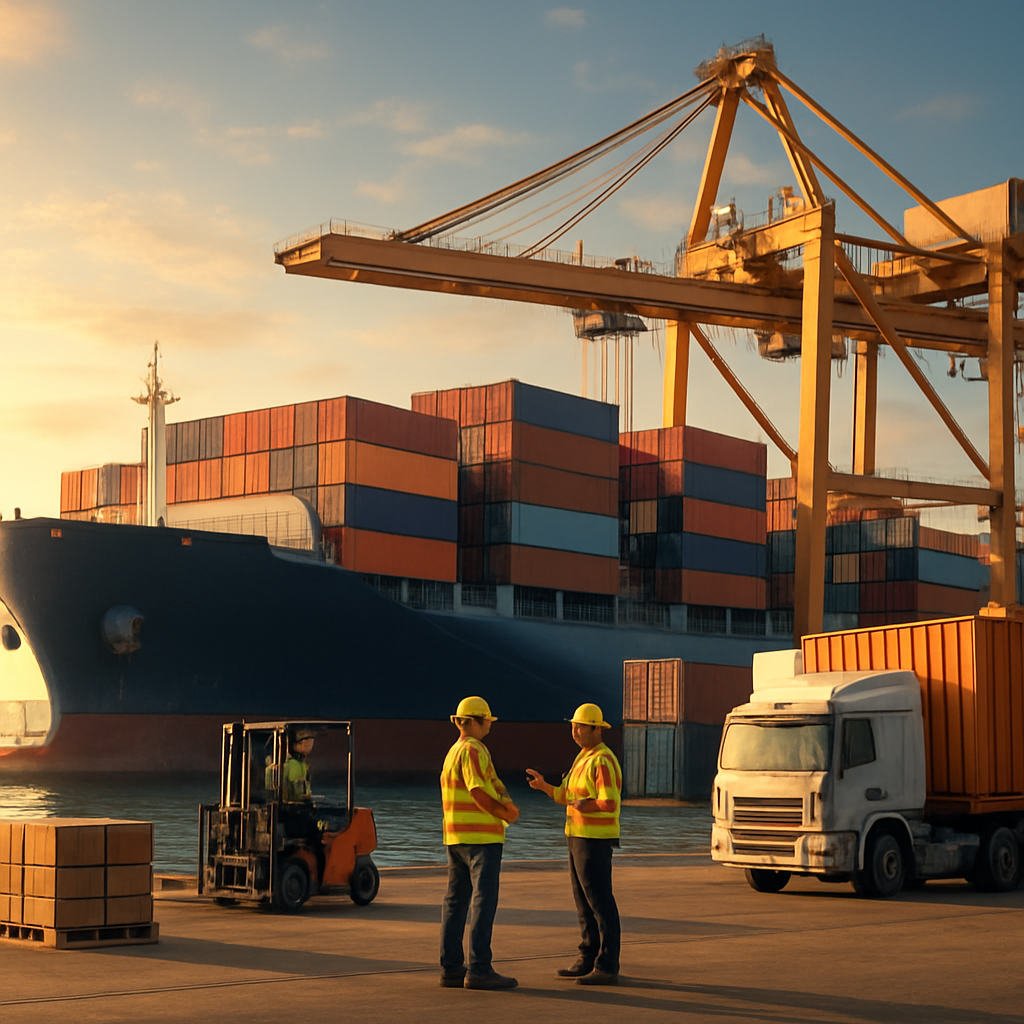
Port-to-Port Freight Movement: Key Insights for Businesses
Port-to-port freight movement is rapidly becoming a board-level issue for Australian supply chain leaders. As container throughput approaches 9.1 million TEUs and sea freight exports near A$467 billion, decisions made at the quay now cascade directly into working capital, customer service levels, and risk exposure. Businesses that still treat port selection and routing as an operational afterthought are missing an opportunity to lock in cost certainty and resilience.
Port-to-port freight movement is no longer a static backdrop to trade; it is a dynamic strategic lever that can either erode margins or underpin competitive advantage.
Port-to-port freight movement is also being reshaped by stark regional imbalances. Western Australia and Queensland dominate port calls, while import volumes have grown almost three times faster than exports over the past decade. This structural gap drives up the cost of repositioning equipment and constrains empty-container capacity. Smart shippers now treat these patterns as variables to be optimised, not constraints to endure.
Port-to-port freight movement and the new economics of cost and risk
Escalating landside port charges, stevedoring fees, and notification costs are compressing margins, often with limited pricing transparency. For many importers and exporters, these “uncontrollable” charges now rival ocean freight itself. Leading operators are responding with lane-level cost modelling, bundling volumes across interstate freight shipping options, and prioritising stability over opportunistic spot rates. The goal is to transform opaque line items into predictable, contractually managed exposures.
Strategic choices: ports, modes, and integrated networks
Strategic port selection can no longer be separated from inland networks. Weak intermodal links, last-mile congestion, and constrained rail paths mean that the cheapest quay-to-quay option may be the most expensive door-to-door outcome. Forward-looking shippers design multimodal interstate transport solutions that combine road and sea freight combinations with carefully chosen coastal freight solutions, ensuring capacity even when global shocks disrupt usual east–west or north–south flows.
Operators such as Domestic & Coastal are increasingly asked to act as strategic advisers, not just carriers. They help clients assess trade-offs between domestic coastal freight services and traditional interstate shipping services, while also mapping how integrated port-to-door delivery supports inventory positioning and service-level commitments. In parallel, businesses are refining local delivery options to align wharf release times, equipment availability, and cost-effective local freight delivery into a single, coherent plan.
Data is the next differentiator. Real-time port performance metrics, contract benchmarking, and stress-testing against scenarios such as Red Sea and Panama Canal disruptions are becoming baseline practices. Resources from organisations like the Bureau of Infrastructure and Transport Research Economics (https://www.bitre.gov.au) provide useful context to validate internal assumptions. To turn insight into action, review your current routing, contracts, and reliable interstate logistics networks, then engage a logistics expert to redesign your port strategy around resilience, not just rate. Now is the time to audit your exposure and reframe port-to-port decisions as a long-term competitive advantage.

Related posts

Amazon Australia’s Robot Operated Warehouse

Underwater Noise From Boats Negatively Impact Marine Environment
Underwater noise from boats can negatively impact the marine environment and vul
Shipping Containers Lost At Sea In Indonesian Waters
Due to heavy winds and high seas, 18 shipping containers were lost at sea off th
